


A few weeks ago I dug into ‘How do you research?’ while Itchy Bitesized 42 asks ‘When do you research?’.
But there’s an even more crucial, and sometimes much more daunting, question which gets asked when I’m teaching, mentoring or running workshops (do get in touch if I can help your and yours):
What Research Does Your Writing Need?
Of course you don’t want the reader to trip up on things they know are wrong: the wildly inaccurate police procedures, the hopelessly anachronistic medieval peasant food. But the more important challenge is gathering what you need to make the characters’ actions and reactions - their journey through this world - believable. And most of what makes things believable is not the material world but how people think and speak, what they feel matters and what they don’t care about.
Anthropologist Edward T. Hall posited a ‘cultural iceberg’ which is very useful for thinking about this. He argued that only 10% of the culture of a society is visible as ‘surface culture’: food, fashions, language, holidays, literature and so on.
‘Deep culture’ forms 90% of a society and, crucially, that’s largely what forms and drives behaviour: for example approaches to courtship, concepts of justice and metaphysics, ideas about sin and death, cooperation and competition, notions of beauty, and so on. This diagram lays it out well:
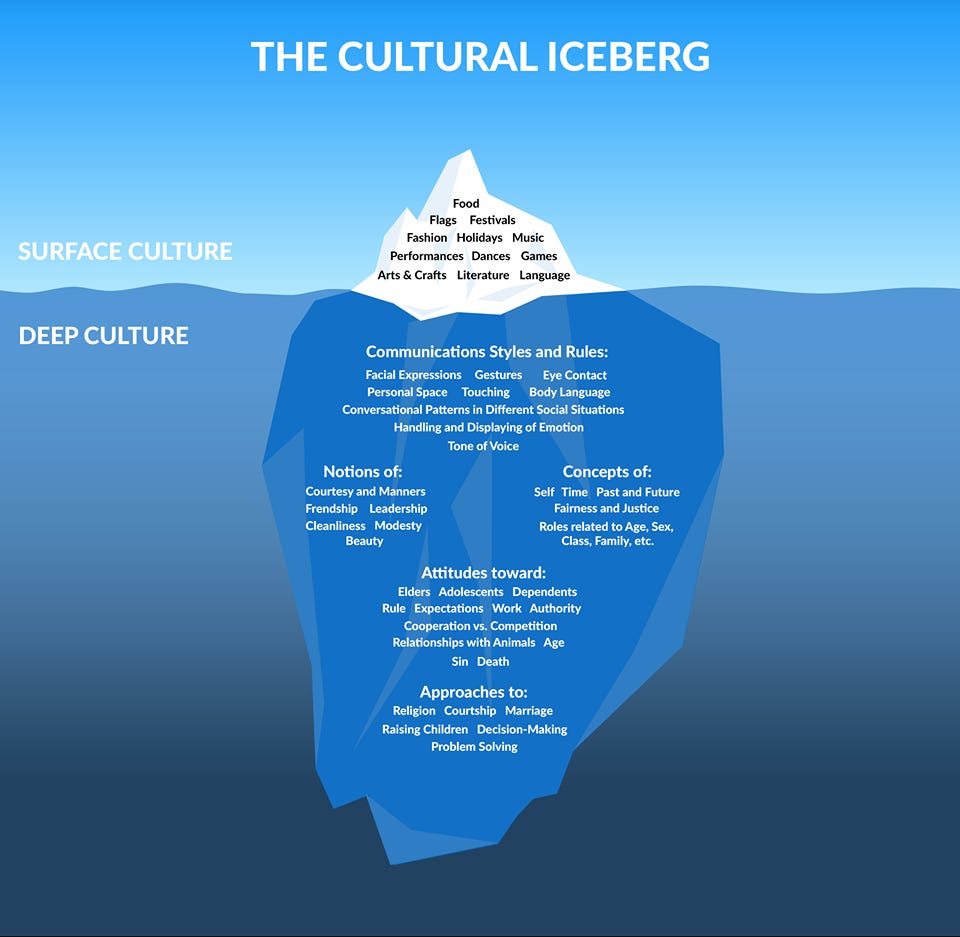
Surface culture and deep culture interact, of course: certain foods are made as part of deep concepts in religion. So both are needed in your worldbuilding, if the reader is to feel safe to make their trust-fall into your story.
What do YOU need to research?
We all have different areas of stuff that we ‘just know’: a mix of things you can’t remember ever not knowing, and things you’ve consciously learnt. For example, if you grew up with horses, much of the time you’ll only have to decide what kind of horse the story needs and you can write everything you need; if you didn’t, you might need to do more research into that, as part of making the horses’ rôle and presence plausible in the story’s different situations. But if a character needs to ride sidesaddle, even keen riders might need to do a bit of digging, then more digging still if it’s their viewpoint character who’s riding, and more again if a crucial plot-point rests on the whole event being plausible.
But for each reader who will find it hard to make the trust-fall into your story because you haven’t evoked the different oddness of riding sidesaddle convincingly, there will be ten who can’t trust-fall because your character’s behaviour towards their teacher, or their children, is unconvincing or anachronistic.
This is where deep culture really comes in, so it’s worth looking hard at the lower section of the iceberg, and thinking about which of these things have an impact on your story, and which you need to find out more about. If you’re writing science fiction and fantasy, of course you can make swathes of this up - but the checklist can still be handy for what you will need to think about and imagine.
What to research: a checklist
I suggest four main headings for thinking about what you need, to reflect their different jobs in your storytelling: Important Facts; Beliefs, Manners and Mores; Voice and Language; and Carnal World. With each, it’s worth remembering
The dictum that ‘story is the journey you make; plot is the route you take’,
Everything varies within a society: geography, period, class (higher, lower and sideways), gender, and many other individual variables. There’s nowt so queer as folk, as they say, so beware the generalising tendencies of other writers
So it’s worth not merely ‘satisficing’ but digging a little further each time to get a sense of the spread of possibilities - plus you often find more wriggle-room in plotting that way.
Beware of the trickiest trap of all: your unknown unknowns. These are the things you think you ‘just know’, so don’t think to find out.1 Proving negatives is famously problematic, so all I can suggest is that when you find yourself writing things your mind is blithely telling you that you know, try to get in to the habit of asking yourself, ‘Are you sure?’.
1) Important facts which affect the plot (‘the route’):
It’s very hard to make a plot work unless you’re on reasonably firm ground on these, because they affect the basics and big structures of how characters act and what happens to them.
travel: forms of transport; travel times; relative costs and practicalities
ordinary life; housing types, costs and practicalities; working, eating and leisure hours; wages, costs and payments
law and order systems; religious structures and sanctions; institutionalised social hierarchies and power-structures
where and how basics such as food, heat, clothing, healthcare and sex are found, made or acquired
2) Beliefs, manners and mores which affect the story (‘the journey’)
These are probably what most often go wrong with historical fiction, but they matter just as much if you set a present-day story in a community not your own, because they’re the foundations of why your characters behave as they do. There’s a reason business people take courses in negotiating in other cultures, and it’s not just so the export director knows how to read the menus.
fundamentals: faith and religion; generational, gender and ethnic roles; class structures and hierarchies; prejudices and stereotypes
community: structures of allegiance and betrayal, and cooperation and competition; relationships across social boundaries; political alignments and oppositions; attitudes to disability
social distinctions: naming conventions; job and personal titles; status signifiers; formal and informal introductions; greetings across social boundaries
daily conventions: dress and decency; head-coverings; cigarettes, alcohol and drugs; greetings such as shaking hands or bowing;
pastimes: sports, hobbies and games; concepts of their rôle in society; approaches to winning and losing;
3) Voice & language: the interface between reader & story
In fiction our medium is also our message, transmitting the story but also part of the worldbuilding, in both narrative voice and dialogue. You’re looking for materials to create a synthesis of the flavours of the Other (in place, time, person) voices of your setting, and the flavours which are native to your ordinary, contemporary writing voice.
vocabulary, syntax, grammar, and sentence structure
the differences in all of those, in formal vs informal situations and contexts
how age, class, gender, ethnicity, job etc. make a difference
slang, swearing and obscenity
heightened, dramatic and poetic language vs functional language
4) The carnal world specifics which helps the reader make the trust fall:
The term ‘carnal world’ comes from Mary Karr’s brilliant The Art of Memoir, and it’s a better than ‘detail’, because it emphasises that this stuff is physical and specific, and it’s key to helping make the reader’s trust-fall possible.
buildings: houses, churches and temples, barns, palaces, share housing/apartment blocks
landscape: terrain, weather, roads and tracks, plants and wild animals
power: fuels, draft animals, sailing ships, engines, motion and movement, mills and factories, big machines
technology: telephones, swords and guns, vehicles again, musical instruments, fireplaces and stoves, hand tools and work equipment
textiles: clothes, sails, underwear, footwear, hats, curtains, tapestries, blankets, industrial garments
furniture: domestic fixtures and fittings, food preparation, workplace fittings
chemistry: food, scent, perfumes, soaps, dyes and chemicals, medicines
bodies: skin, hair, height and weight, sex, singing, dancing, makeup, body ornaments and modifications, washing and bathing, types of exercise, habits of movement
art: religious and secular jewellery, paintings, ornaments, ceramics, fashion, instrumental and vocal music
And finally, don’t forget that all these things don’t just look certain ways to our sight, they have smell, sound, texture and taste, plus what I think of as ‘the real sixth sense’: the way they interact with our own proprioception as we handle them or they envelop us.
My go-to example of things everyone knows used to be, ‘Of course, no one would make their medieval English peasants eat potatoes’ until a workshop participant asked, ‘Why not?’. In reverse, many people are surprised to know that William the Conqueror, as an élite duke-cum-monarch, would have eaten rice without any surprise in 1066 London. In my experience, many of our unknown unknowns are not complete blanks, but such simplified versions that essentially they’re wrong. After ten years researching The Bruegel Boy, I often have to remind myself that most people’s idea of the different Inquisitions in Europe starts with Monty Python’s take on the Spanish Inquisition, and doesn’t get much further.