


The question of how to do research comes up almost as often as the question of when to do it (click through to Itchy Bitesized 41 for that one), and it’s worth thinking about.
There’s a built-in tension between your need for precise information and experience, and your need not to limit yourself to that, but to stay open to seeing things you didn’t know were there, and weren’t looking for.
And as I’ve just said in my new website page of Further Reading for The Bruegel Boy, all that material still needs to get into Rose Tremain’s ‘anarchic, gift-conjuring, unknowing part of the artist’s mind’, ready for the reimagining which includes ‘some measure of forgetting’.
This is why research for fiction is not at all the same as research for non-fiction, even though your sources may look very similar. We are in the business of evocation and verisimilitude, not representation and analysis. That’s also why, much of the time research is ideally a two-step process: a first, ‘reading-round’, free-search phase that shapes your initial ideas and work on the project, and then a second, revisiting of the same material when you know which bits you want more of - and fresh work on stuff you didn’t know you needed.
Online Sources
Most Wikipedia articles will give you a useful overview and super-useful links and references at the bottom. The detail in some articles can be astonishing, but don’t forget that everyone starts at Wikipedia, so it’s unlikely to help you ‘make the strange familiar and the familiar strange’ that is so crucial to writing a vivid world and its people. If you’re researching a country other than the UK/US, that country’s own Wikipedia will often have a lot more material on its smaller places and native topics: get Google (not Wikipedia) to translate the pages you need to.
Beyond Wikipedia, in my experience most websites that appear to be about your topic regurgitate the same old limited stuff. Having said that, if you’re lucky some glorious enthusiasts will have set up a website: matchlock muskets, the history of the parish church, fourwheelers-versus-hansom cabs, lace-making, ale-versus-beer… Just keep googling, remember that cut-and-paste doesn’t get information into your head the way physical notemaking does, and never leave a site that you got anything from, without bookmarking it.
Books and articles
Libraries are wonderful and librarians are trained to help, while the online catalogue of the British Library and its equivalents should point you in useful directions - and even send you the book via inter-library loan. Google Scholar will find you pulrely respectable, peer-reviewed material; both it and JSTOR are terrific, if you can get access, for bits and scraps from the sort of close-up primary research articles which do give your writing the sting of the new and strange.
If you’re lucky, someone’s written the book you need. More often, we’re triangulating between different books about different things which will only get merged in your novel. But it always pays to be ruthless: perhaps you only need to read the introduction and a single chapter, to get what you need: as Francis Spufford says of On Golden Hill
I deliberately stopped trying to discover more … I wasn’t writing historical biography, and I already knew who I wanted [these two men] to be … I’m not a scholar. I know how ruthlessly willing I am to learn just enough and no more to make the view look convincing.
Making notes is the fundamental way to get the content into your head but it’s easy to end up making notes about everything, which is useless as well as time-consuming. For what it’s worth, if I possibly can I download and print the article, or buy the book.
If your local library or independent bookshop can’t help you to a copy, Abebooks is often cheaper and has more choice than The Online Retailer Who Must Not Be Named for both new and second-hand copies, and even though Abebook is actually owned by ThORWMNBN, booksellers tell me that the fee structure is quite different, and much more to the bookseller’s benefit.
I can then make notes in the margin like this:
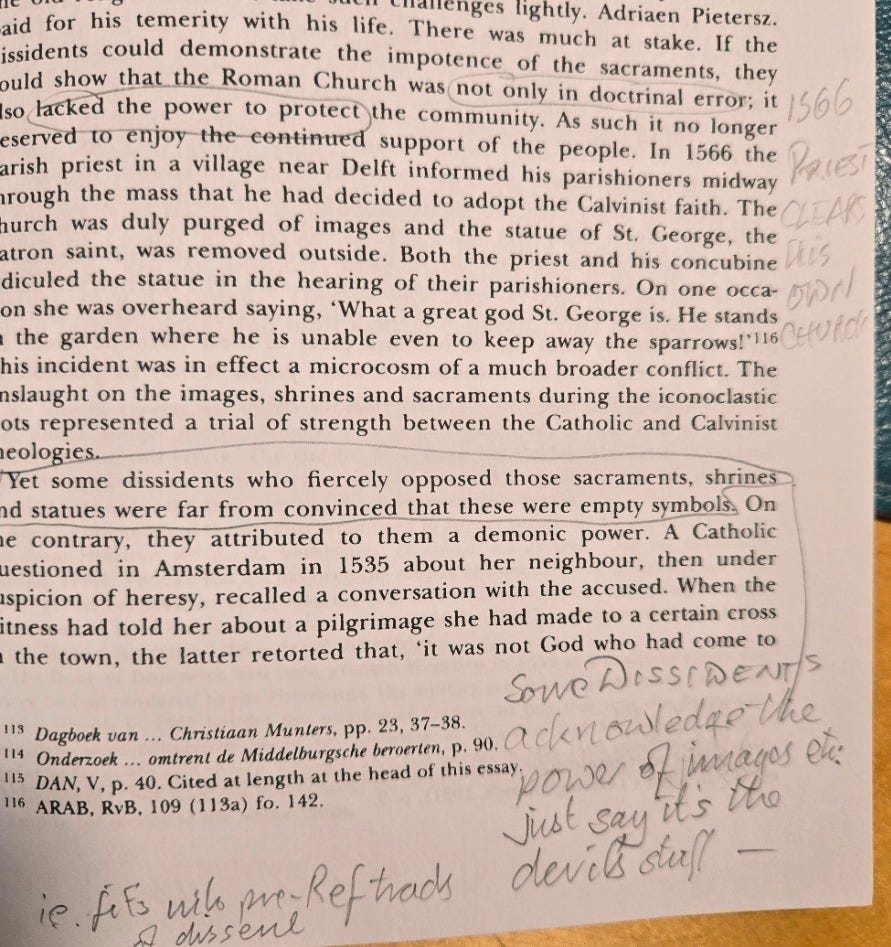
The words in capitals I think of as ‘indexing’ and if I don’t own the book I make separate written notes in the same spirit. Don’t used post-it notes on someone else’s book: librarians know that the sticky residue is damaging, and very hard to erase.
But whatever you do, always, always make a note of your source, including the page number, and which library you got it from. It’s maddening to find a note months later, realise it’s crucial to know more about this thing, and have no way of retracing your steps to find that more.
Pictures and art
Now that art history has embraced the social-historical-cultural aspects of creating art, art historians show us what can be found by the free-searching novelist: this new post by George Bothamley is a lovely example. Of course George has specialist knowledge, but any of us can look at a painting or sculpture and think, ‘What does this show me (even if it doesn’t tell me) about the things it represents, the person who made it, the making of it, and the people who might own or view it’.
Of course Wikimedia Commons is a fabulous source, but don’t ignore how different the experience of the real, physical thing is if you can get there: scale, 3D-ness, context, lighting and the sheer physicality of the materials, experienced together, make a direct encounter a completely different thing. So get there if you can.
When at the last minute I scraped together the money and time to whizz to Vienna for a once-in-a-lifetime exhibition of Bruegel paintings, I was taken aback by how they are… not exactly small, but definitely not big. I might have computed some of that from the measurements in the more scholarly art books, (though it’s shocking to me how even scholarly books about photography often tell you zero about the physicality of the actual, original, prints.) But without the cheapest flight to Vienna I could find, and an even cheaper hotel, I’d never have felt the intimate connection I did standing before something like Landscape with the Flight into Egypt, and that fed directly into The Bruegel Boy. And then it snowed…
Places
It’s astonishing what you can do these days with Google Image Search, Satellite and Streetview. Travel guides are well worth using for a curated, intelligent overview (rather than TripAdvisor) and if you’re writing historical fiction and can lay hands on, say, a Baedeker of the right date, so much the better.
But if you can get to the place it always helps. Particularly if you won’t be able to the two-step return, it’s really worth thinking beforehand about what you’re hoping to get out of the visit:
geography: rivers and hills, flora and fauna, the colour of the earth, alleyways and staircases
atmosphere: scents, sounds, feels, details, symbols, light and shadows,
specific buildings - the town hall, the castle - that you’ll use undisguised
general models to base imagined places on: the contour and scale of the landscape (surprisingly hard to tell from Google), suitable homes/shops/factories to adapt for your characters.
museums and the tourist office for historical info, books and postcards
Then look at your story and plot, what you need and where might give it to you, and make a plan of campaign. Transport, travel times, opening times, car hire arrangements, and anything that you need an appointment to access all come into the plan - but leave yourself enough room to wander around, follow your nose, be led by new ideas for the story, and seize unexpected opportunities.
For a longer trip I’d also suggest keeping some kind of journal, noting down the atmosphere that photographs can’t capture, and catching and pinning down how your thinking and plans for the story are evolving. And consider taking a decent camera rather than just your phone: nice pictures are excellent material for substack, illustrated talks, and promotion online.
Audio-Visual
Mining videos, documentaries and podcasts is much like mining books, except that they’re more annoying to flip to and fro in - but at least podcasts have show notes for their sources.
Making notes really is your friend for these - but don’t forget the Rule of Three: if you’re to get past the level that everyone knows, and the one that some people know, to the third level which will have the sting of the real and new, you will probably have to dig back from what’s on film to its source.
But interviews and oral history recordings can be fantastic for hearing voices and specifics, vintage footage has similar value, and I’ve recently taken to using audiobooks for the rolling-round stage, with the option to buy a physical copy for notemaking if I need to.
People
YouTube has vastly increased our access to information without having to make direct human contact, but you still may find emailing or talking even better. Most people love talking about their specialisms, but they’re still doing you a favour: think out what you want to know so you don’t waste their time, but again be open to the unexpected opening up as you go. Be polite, remember they are giving you a slice of their 4,000 weeks on this earth, take No for an answer, make notes as well as - with their permission - recording the conversation, and send them an invitation to the launch.
But also remember that this person is not the only, absolute authority either: no one person can be (except on their own life, I suppose) - and they may not really get difference between what they personally know, however authoritatively, and what will be plausible for the reader. You are still at liberty to do as you choose with what they tell you, including changing it or ignoring it.
Still, as I said in This is Not a Book About Charles Darwin, in writing the disaster novel about my family,
I knew I would find it incredibly difficult to reject, creatively speaking, what [any] interviewees said about the real people I had taken for my characters, even when what I wanted to do instead was emotionally and creatively valid. I couldn’t – I wouldn’t – give anyone else such power over my empire.
So I didn’t interview anyone. And no, there were many reasons for the disaster but that decision wasn’t one of them. Your book, your rules, and check this post if you’re worried about staying ethical.
Don’t use fiction as a research source
It’s not a good idea to use other people’s fiction - novels, plays, films - as research sources for your fiction. Not only do you risk taking for fact what is actually the author’s invention (that was how Georgette Heyer knew that Barbara Cartland had plagiarised her), you risk plagiarism or breaching the author’s copyright.
Even more likely is that what you write will have that third-hand, standard-issue flatness. If you write a scene in New York’s Central Park based on watching half a dozen movies, readers have seen those movies too, and we’ll smell that your scene is off-the peg. If you want to use things you met in a novel or a film, track them down to a non-fiction source and then you can work honestly and creatively from there.
The only exception to this rule is if you want to use, say, 1920s-written fiction as research material for your 1920s-set historical novel. It can be a gold-mine of information about manners, mores, social codes, clothes and all the rest, so go ahead.
And finally
as I said in When Do You Do Your Research?:
It’s really worth accepting that there is no single, perfect version of a finished story that you must strive towards, which means there’s no single process which can lead to that perfect version.
On another day, with a different mood, train, weather, or copy of the book, you might end up with a slightly different novel. So be it.
Thanks Emma - this is so helpful for me as I'm knee deep into research at the moment :)