


When I’m giving workshops on Historical Fiction, the question of ‘When should I do my research?’ comes up almost every time - and ‘When do you do your research?’ comes up almost as often at bookish events.
Of course, it’s a rare novel which doesn’t need you to find out something - if only what was on the news the year you turned ten - and I’ve dug into the How of doing research here.
But the question of When looms particularly large over any project set in a world that the writer can’t know directly. That’s the very definition of historical fiction, of course, but it’s just as lively for those setting their story behind the scenes in a nuclear reactor or the National Theatre, or on the planet Zog, or in their own home town in the year 2157.
Part of the answer, of course, is ‘When you can’: when the childcare or respite-care stars align; when the tiny local library with its cache of local history material is actually open; when the other job sends you somewhere anyway; when there’s a special offer on the fare; when the expert who’s agreed to chat can actually fit you in.
In everything to do with writing it’s really worth accepting that there is no single, perfect version of a finished story that you must strive towards, which means there’s no single process which can lead to that perfect version. Whether you find that horrifying or liberating is perhaps a matter of temperament, but the skill of the artist is to know when to refuse or fight the obstacles to reaching that imaginary, unattainably perfect version, and when to fold them into the process.
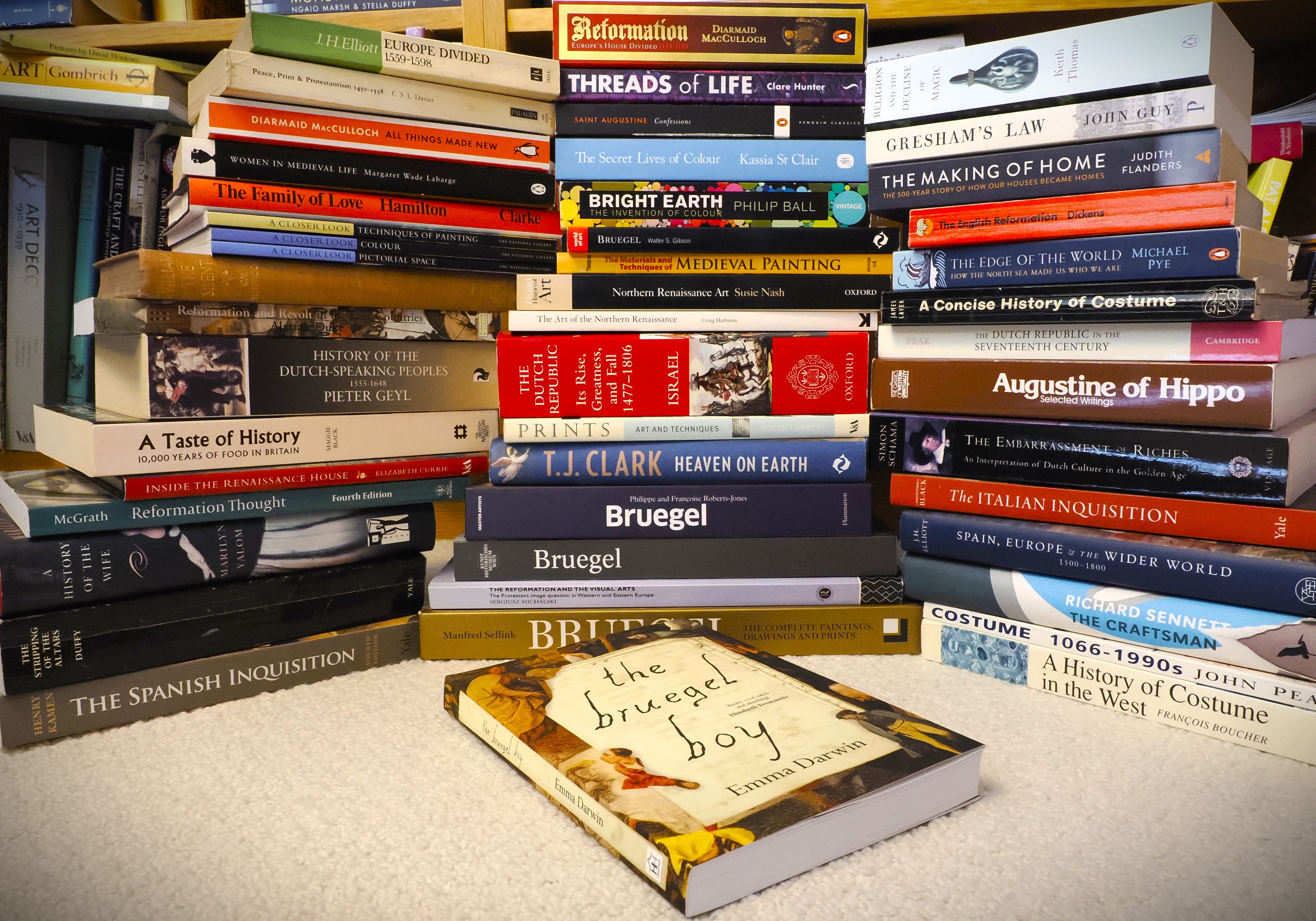
Research we must, however: the photo is of the books I’ve just pulled back off my shelves to make the slightly belated Further Reading page on my website for The Bruegel Boy - and of course we want it to serve our creative purposes as well and fully as possible.
But although it’s obvious what we gain by researching, what might we lose? Rose Tremain’s quote is key, here; there’s more in that link, but what matters here is this bit:
[In] the novelist's task of reimagining reality[,] reimagining implies some measure of forgetting. The actual or factual has to lose definition, become fluid, before the imagination can begin its task of reconstruction. Data transferred straight from the research area to the book will simply remain data. It will be imaginatively inert. [my italics]
When Should You Do Your Research?
If we categorise the timing of your research into four basic relationships to the first draft, we can look at the advantages and disadvantages of each possibility - and that should help you make the most of the pros, mitigate the cons, and make your peace with all those cloudy, dreamy, ‘other’ versions of your story that might have been, had you done things differently.
Early ‘roll around’ in the material for your new idea: reading freely, making some notes, visiting sites
Pro: you absorb the broader landscape, experience and voices of this world; it’s an early warning if something turns out to be impossible or too difficult; ; it’s a good first dip into what you think you’ll need and a means of mapping the material to go back to later; notes can help things stick in your brain, but be ignored later; there’s plenty of time for the essential ‘forgetting’ to happen before you start drafting
Con: the project may change later so the time you spent seems to be wasted; you may not seek and gather specific info you later turn out to want, but can’t easily go back to1; your Inner Critic may shout that it’s stupid to spend all this time/effort/money when you don’t know what you need
Research while planning the first draft: getting practical about what’s needed
Pro: you won’t plot based on guesses and risk major reworking; you hear the historical voices which can start to compost into the voices of your novel; you stumble on riches you didn’t know to look for; there’s still some time for ‘forgetting’
Con: you don’t know what details you need; you can get bogged down or daunted in the sheer volume of material; research is crack cocaine for procrastinators; as you develop the story the research-tail risks starting to wag the story-dog
Research during the first draft: popping out of the writing room to grab what this scene needs
Pro: you can tailor what you research efficiently to what you need at this moment; you can feel reasonably confident in that as the basis for the next several chapters; the voices of letters and diaries can flavour and shape your prose
Con: there’s no time for ‘forgetting’; there’s maximum risk of ‘inert data’ hitting the page; the research-tail is even more likely to wag the story-dog; all that vivid material can result in Too Much Stuff on the page.
Research after the first draft: parking the draft in a drawer and getting back out there
Pro: you know what this story is and what you need; your more exact questions about specifics are more likely to dig up fresh and interesting answers; the story-dog is more substantial and sturdy, so the research-tail is less likely to wag it; it can work well as a way getting some distance from the first draft before you start back in revising, while still feeling you’re working on the novel
Con: you may discover you ‘can’t’ do what the story needs; it’s hard to ignore solid facts and authoritative interpretations that you find but which cause your story problems; you may not be able to use riches you stumbled on relatively late in the day; when you do find something thematically or historically delicious, the temptation to distort the story to fit it in may be hard to resist
Fortunately just being aware of the drawbacks of researching at each of the points may well be enough to avoid the worst of them at the time - and to help you spot and edit out the rest later.
And Finally
I’ve posted before in and around the business of research, so these links should also help:
how ‘write what you know’ is both a ridiculous command, and a gold standard, for writing what you don’t yet know;
how good research is merely necessary to good writing and never sufficient;
how what historians write may even be counter-productive and
how to cope when the facts - or the ‘facts’ - mess with your fiction
For what it’s worth, I’m a big fan of ‘rolling around’ in the material - not least because it’s such fun - and over the years I’ve learnt that it’s also wise to check the broad structural questions of time and geography early in planning, because they can wreck your plot like few other things. And, personally, I never write worse prose than when I have a history book at my elbow, so I tend try to avoid researching during a first draft, and simply generate a big list of things to find out once it exists and I know what this story needs.
But that’s just me: other writers find that feeling their factual feet are on solid ground at every step is the only way to hold on to their confidence in their storytelling.
As so often, what matters is that each of us understands the drawbacks our chosen processes might have - and plans how we will overcome them.
This is why I would suggest that, however casually you’re reading round, you always make a note somewhere of which library, which website, which museum or building, these photos, notes or facts came from. There’s nothing more maddening than coming on a hint in your notes of some fabulous or deeply surprising piece of insight or information, and not being able to work out where on earth you got it from, so you can go back and find out the rest.
Your final paragraph about the necessity of noting down where you found any particular nugget of useful information found when researching is well worth pinning to my desk. I've often forgotten the exact source in my scribbled notes and have wasted much time I haven't got. It's so frustrating. Never again, thanks to your advice.
Great post! I've found it useful to research throughout my writing project - books, films, TV shows, podcasts. I'm currently on my third draft and have been revisiting sources I read earlier on during the first and second drafts. It's so interesting to find that parts of those sources hold a new significance now that I know more about what kind of story I'm writing. (And this is also a very good reason to revisit any general notes/brainstorming from the early stages - it turns out that past me had some excellent ideas that only present me can really appreciate!).