


This new Book Post section of This Itch of Writing celebrates books, from very old to very new, that I’ve enjoyed and hope writers will not only enjoy but find useful for their own writing. Click the link or the tab at the top of the page to explore the growing list. All the books are available at the Itch of Writing Bookshop at bookshop.org, which supports independent bookshops; the Itch also benefits directly from a small commission.
I CAPTURE THE CASTLE, by Dodie Smith
Cassandra Mortmain is seventeen, and has decided to keep a journal to practice her speedwriting in the hope of being able to get a job. It’s the 1930s, and she, her older sister Rose and schoolboy brother Thomas live in a tumbledown castle in Suffolk, which their writer father moved into in happier times, after the succès d’estime of his Finnegan’s-Wake-like novel. Then he succumbed to writer’s block and the money ran out, and now they quite often go hungry: even the towels are so threadbare ‘we have to shake ourselves dry’. The girls have been neither bred nor educated to earn a living, but nor do they ever meet anyone to marry. Their stepmother Topaz, ex-artists’ model, just about keeps everyone fed and clothed, when she’s not communing with nature or playing the lute; only Stephen, the lad who grew up with them and has always been embarrassingly devoted to Cassandra, brings in any money at all.
And then one wet night Simon Cotton, the young, anglophile, American man who’s unexpectedly inherited the estate, turns up with his brother, all-American Neil. They make friends with clever Cassandra, their glamorous mother lionises Mortmain, while Simon fall in love with astonishingly beautiful Rose. Cassandra observes the progress of their courtship, the faultlines in her father’s marriage, and her own indifference, curiously: ‘I know all about the facts of life,’ she writes, ‘And I don’t think much of them’.
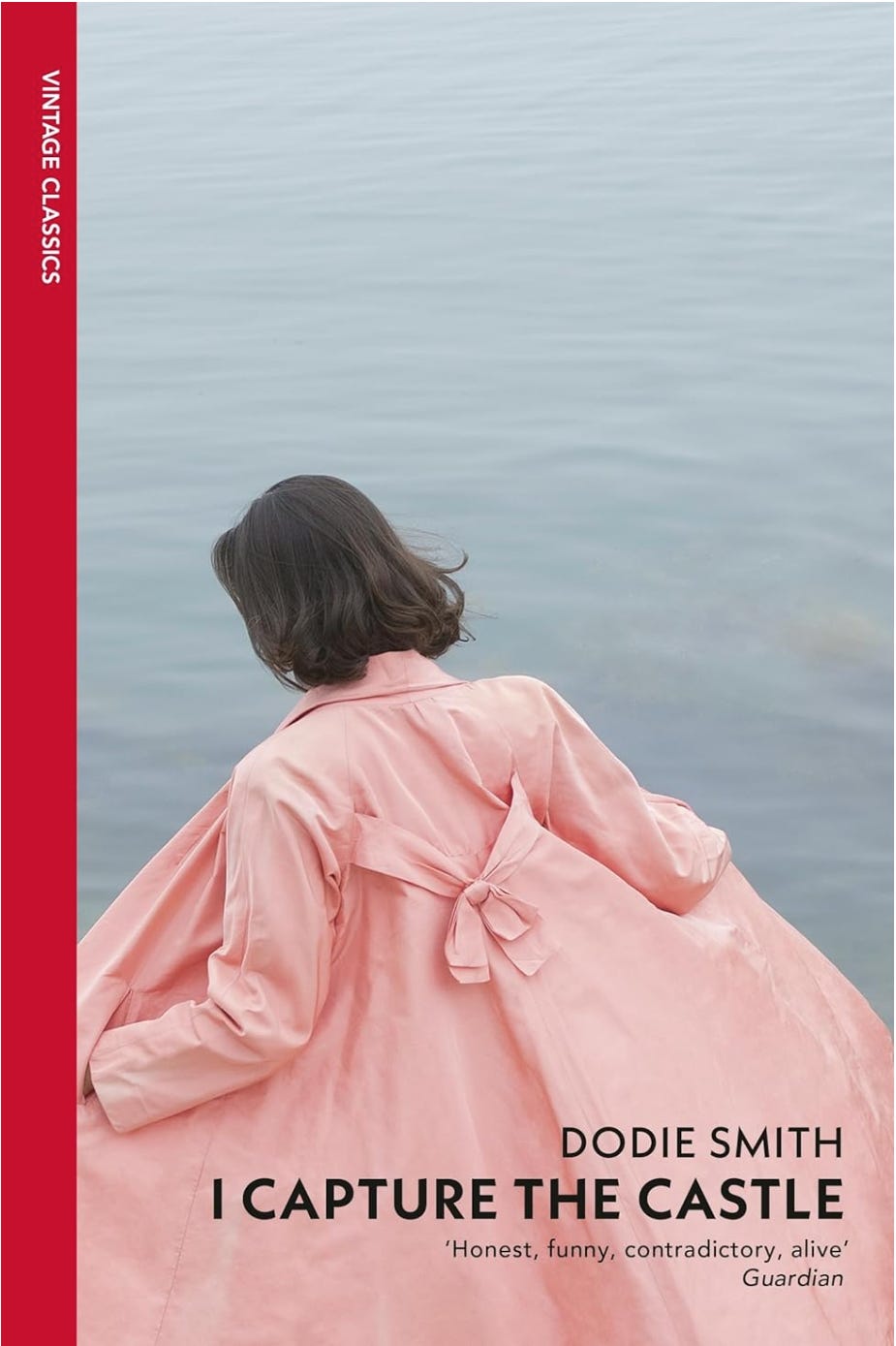
Why I love it:
‘I write this sitting in the kitchen sink’ is possibly the best opening line ever, and every sentence of this post could have been illustrated with an equally good one. And it’s not just funny: it also sets the reader up very precisely for how this novel is going to work. Cassandra starts observing their lives just as everything is about to change, and the journal/novel is partly formed by what she observes, but also by how the events change her, ‘poised’ as she is ‘between childhood and adultery’, as Valerie Grove puts it in the introduction in my Virago Classics edition. Refracted through the needs of a very different project, the structure was a big influence on the structure and narrative setup of The Bruegel Boy.
I Capture The Castle is a minor classic of the growing-up story, and the years of its demotion (as some would see it) to Young Adult fiction avant la lettre must have kept it a secret from many adults: currently the only new physical edition I can find has possibly the most awful cover of any book I’ve ever seen, which is why the one I’ve pasted in above is the ebook. That’s a shame, because the novel is centred on one of the great human tragicomedies: the deal we all make in gaining knowledge and experience is also a loss of innocence. Both Anna in The Mathematics of Love, and Una and Mark in A Secret Alchemy owe a sizeable debt to the book.
Although the evocation of the Suffolk seasons (by a painfully homesick Dodie Smith, writing in wartime Hollywood) are quite beautifully done, the book is never saccharine. ‘It’s not a very good game,’ Cassandra thinks almost at the end, contemplating the patterns of love, sex and self-deception that have yoked each of the characters to someone else. ‘The people you play it with are apt to get hurt’.
Three reasons for a writer to read it
It’s a good example of how the writer can convey things through a character-narrator that the character themselves doesn’t think. Cassandra loves Rose unconditionally, for example, while we see her from another angle. Mind you, when I first read I Capture the Castle as a teenager myself, I took much of the story at Cassandra’s face value, as it were. Returning to the book in my thirties, I saw more of the satirical edge, and admired Smith’s skill in allowing us to pick up the satire through observant and detached but essentially un-satirical Cassandra: different readers (and different ages of reader) will read different things between the same lines.
That structure. I’m always going on, here on the Itch, about the question of ‘Where is the narrator standing, relative to the events of the story?’, and the answer in this case is ‘very close’. But this is not a brain-download: it’s a brilliant example of the value of using past tense and the storytelling mode. This is no would-be movie-script, present tense, first-person, all about the moment. The small but built-in distance that diary-form brings means we know very well that this is Cassandra’s take on her world and, literally and figuratively, her construction of what happened. Indeed, the journal and Cassandra’s writing of it become part of the plot/route, as well as part of the story/journey: she (and we) are aware that how she feels in the ‘now’ of the writing affects what and how she writes. Nor does that seem complicated and self-conscious, because diary-form come so naturally in reflecting the kind of awareness that we all bring to our lives, especially as teenagers.
Interestingly, the film of I Capture the Castle is really rather good, even though the book’s form and structure is so – well - booky. Although I Capture The Castle was Smith’s first novel (long before The Hundred and One Dalmations), she was already a highly successful playwright: the structure of the story conveys the randomness and boredom of ordinary country life while in fact the narrative drive never slackens. The dialogue, too, reflects Smith’s playwriting expertise, and you could argue that so does the voice of the journal, being both vivid and immediate, and yet convincing as a written thing. Even the dog, Heloïse, and Abelard the cat, are part of the pattern, as gradually everyone is drawn into a complex dance. It’s Cassandra’s own story that turns out to be a funny, vivid, painful process of growing and maturing.
And did I mention that it’s also very, very funny? It’s one of those books that, if you meet a fellow fan, can guarantee companionable giggles: the legless ghost, the bearskin coat and then the bear, the crinoline, Leda Fox-Cotton, the shaving scene … I’ll stop there; you’ll just have to find the rest yourself, and join the club.